Architectural drawings and prints · Artist profile · Market guide
Giovanni Battista Piranesi
1720–1778 · Venice and Rome. Architect, archaeologist and the greatest etcher of architecture – from the views of Rome to the Imaginary Prisons.
Rome, larger than life
Giovanni Battista Piranesi trained as an architect in Venice and moved to Rome in 1740. He built very little – but his etchings of ancient and modern Rome shaped how all of Europe imagined the city. Travellers on the Grand Tour took his Vedute di Roma home as souvenirs: large, dramatic views in which ruins tower over tiny figures.
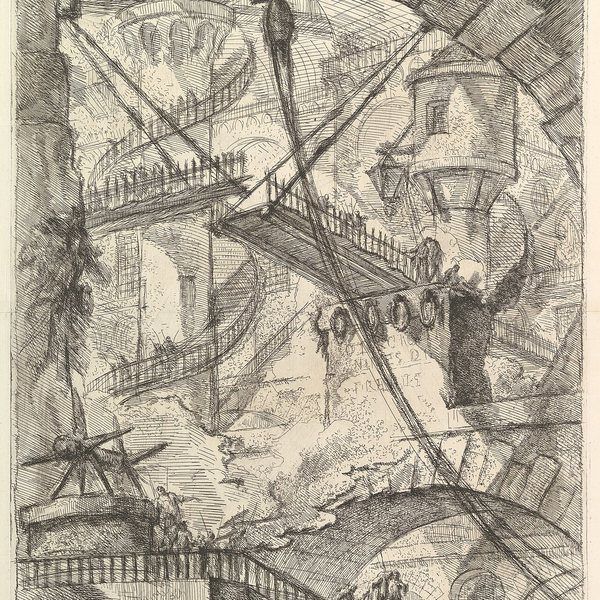
His most famous and strangest work is the Carceri d'invenzione – the Imaginary Prisons. The first edition of around 1750 had 14 sketch-like plates; in 1761 Piranesi reworked them, darkened them and added two more, for a set of 16. Endless stairs, bridges, chains and vaults have fascinated artists, writers and film designers ever since.
Piranesi published his own plates, and they were printed again and again: by his son Francesco, later in Paris, and in the 20th century by the Calcografia in Rome, which holds the copper plates. The age of the impression therefore matters enormously. A first-state Carceri plate sold for $6,930 in 2023, while later Vedute impressions are regularly estimated between €100 and €1,200.
Timeline
- 1720Born on 4 October in Mogliano Veneto, near Venice.
- 1740Moves to Rome as a draughtsman.
- 1748Begins the Vedute di Roma, which he continues until his death.
- c. 1750First edition of the Carceri d'invenzione, 14 plates.
- 1761Second, reworked edition of the Carceri, 16 plates.
- 1778Dies on 9 November in Rome.
- 1799His son Francesco takes the plates to Paris; later editions follow.
Techniques and media
With Piranesi, almost everything is an etching – the question is when it was printed.
Etchings, lifetime impressions
Printed in Rome during Piranesi's life – the most sought-after, especially first states.
Paris editions
Printed after 1799 from the same plates, first by Francesco Piranesi, then by later publishers.
Calcografia restrikes
20th-century impressions from the original copper plates held in Rome – genuine plates, but late impressions.
Bound volumes
Complete or partial sets of the Vedute or other series in original bindings.
Drawings
Rare preparatory drawings in pen, chalk and wash – a separate, much more expensive market.
What Giovanni Battista Piranesi works sell for
Prices below are public auction results. They show the range – not what a specific piece is worth.
Example: L'arco con un ornamento di conchiglia, first state, $6,930 at Toomey & Co., 2023.
Typical estimates for single views at HAMPEL; early impressions of famous views fetch more.
20th-century impressions and photomechanical copies are decorative.
Highest auction results
| Work | Price | Auction |
|---|---|---|
| L'arco con un ornamento di conchiglia (Carceri, first state), c. 1750 | $6,930 | Toomey & Co., 2023 |
Estimates for single Vedute di Roma at HAMPEL range from €100–130 to €900–1,200, depending on view, impression and condition.
Real or not? What to check
Most Piranesi prints are genuine etchings from his plates – the question is the impression. Watermarks, paper, the sharpness of the lines and the state of the plate (added numbers, publisher's lines) help date a sheet.
- Plate mark: An etching has a pressed rim around the image. Without it, the sheet is probably a photomechanical reproduction.
- State and numbering: Later editions often show plate numbers or changed inscriptions. Compare with the catalogue raisonné (Hind, Wilton-Ely).
- Paper and watermark: Hold the sheet against the light: watermarks can point to Roman or later Paris paper.
- Line quality: Early impressions are deep black and crisp; late ones grey and worn.
How much is a Piranesi print worth?
Single views of Rome are often estimated between €100 and about €1,200; early impressions of famous views and first states of the Carceri fetch much more – around $7,000 for a first-state Carceri plate in 2023.
Is my Piranesi a restrike?
Possibly. His plates were printed after his death in Paris and in the 20th century in Rome. Paper, watermark, numbering and line quality help to tell.
Do you own a work attributed to Giovanni Battista Piranesi?
Start with a free estimate from photos. For a sale, insurance or an estate, order a written appraisal by an independent expert with a notarized signature.
Sources (auction figures as published there):
- Toomey & Co. – Piranesi, L'arco con un ornamento di conchiglia (first state), July 2023
- HAMPEL Fine Art Auctions – Giovanni Battista Piranesi
- Wikipedia – Carceri d'invenzione
ArtworkValue is not affiliated with any museum, dealer or auction house. This page does not offer works by Giovanni Battista Piranesi for sale.