Japanese woodblock prints · Artist profile · Market guide
Kawase Hasui
1883–1957 · Tokyo. The leading landscape artist of shin-hanga – quiet snow, rain and moonlit temples in the 20th century.
The new print, in the old way
Kawase Hasui was the most important landscape designer of shin-hanga – the «new prints» movement of the early 20th century. Together with the publisher Watanabe Shōzaburō, he revived the traditional division of labour between designer, carver and printer, but with a modern eye for light, atmosphere and Western perspective.
Hasui travelled throughout Japan and produced hundreds of designs: snow at temples, rain in village streets, evening light on lakes and harbours. Many blocks of his early work were destroyed in the Great Kantō earthquake of 1923, which is why some designs exist in very few early impressions. In 1956 he was designated a Living National Treasure.
His prints were popular abroad from the start, and Watanabe printed many designs again and again – during his lifetime and after his death. That makes the edition decisive: early lifetime impressions of the best designs have fetched $9,800 to $16,000 at auction, while later and posthumous editions trade at a clear discount.
Timeline
- 1883Born in Tokyo.
- 1918First print series with the publisher Watanabe Shōzaburō.
- 1923Great Kantō earthquake destroys many blocks and prints.
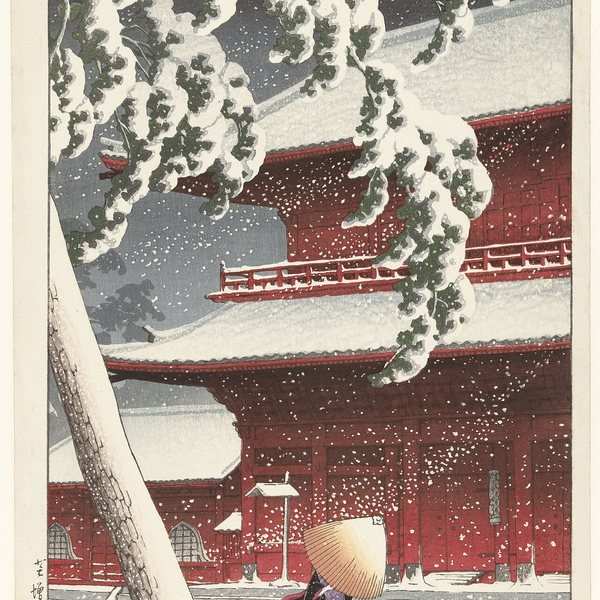
- 1925Zōjō-ji Temple in Shiba, from Twenty Views of Tokyo.
- 1956Designated a Living National Treasure.
- 1957Dies in Tokyo.
Techniques and media
Hasui's prints are woodblock prints throughout – what differs is when they were printed.
Lifetime impressions (Taishō and early Shōwa)
Printed during Hasui's life, especially 1918–1930s – the most sought-after.
Later lifetime impressions
Reprints from the same blocks during his lifetime, often with different seals.
Posthumous editions
Printed after 1957 from original or recut blocks – collected, but cheaper.
Small formats
Some designs were also issued in smaller sizes; these usually fetch less.
What Kawase Hasui works sell for
Prices below are public auction results. They show the range – not what a specific piece is worth.
Artelino auction results 2023–2025 for famous designs such as Shiba Zōjō-ji.
Collected, but clearly below early lifetime impressions.
Decorative only.
Highest auction results
| Work | Price | Auction |
|---|---|---|
| Twenty Views of Tokyo – Shiba Zōjō-ji, 1925 | $16,000 | Artelino, 2023 |
| Souvenirs of Travels I – Senjo Cliff at Lake Towada, – | $15,000 | Artelino, 2025 |
| Zōjō-ji Temple in Snow, – | $9,800 | Artelino, 2025 |
Results as published by Artelino, a specialist auction platform for Japanese prints.
Real or not? What to check
With Hasui, the edition matters more than anything. The publisher's seal in the margin and the style of the artist's seal help to date an impression – compare them with reference literature or ask a specialist.
- Publisher's seal: Look for the Watanabe seal in the margin; its form changed over the decades and helps date the print.
- Artist's seal: Hasui's signature and seal also appear in several variants.
- Paper and colour: Early impressions often show a rich texture (baren marks) and subtle gradations.
- Condition: Fading, toning, trimmed margins and backing reduce value considerably.
How much is a Kawase Hasui print worth?
Early lifetime impressions of his best designs have sold for about $10,000 to $16,000. Later lifetime printings and posthumous editions sell for considerably less, and condition is decisive.
Do you own a work attributed to Kawase Hasui?
Start with a free estimate from photos. For a sale, insurance or an estate, order a written appraisal by an independent expert with a notarized signature.
Sources (auction figures as published there):
ArtworkValue is not affiliated with any museum, dealer, publisher or auction house. This page does not offer works by Kawase Hasui for sale.