Architectural drawings and prints · Artist profile · Market guide
Frank Lloyd Wright
1867–1959 · Chicago, Taliesin. America's most famous architect – whose drawings, portfolio plates and designs are collected worldwide.
Drawing a new American architecture
Frank Lloyd Wright designed more than a thousand buildings, of which over 500 were built. From the low, horizontal Prairie houses around Chicago to Fallingwater and the Guggenheim Museum, he developed an architecture that grew out of the landscape. Drawing was at the centre of his office: perspectives, plans, elevations and details, many drawn by his assistants and later by the apprentices of the Taliesin Fellowship.
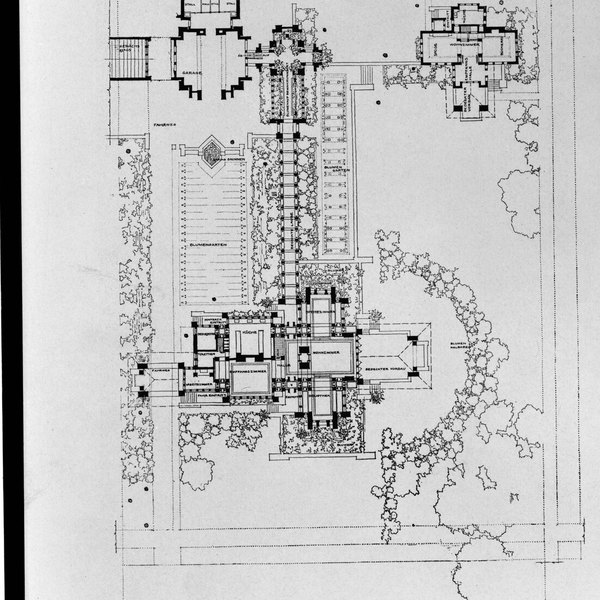
In 1910 the Berlin publisher Ernst Wasmuth issued Ausgeführte Bauten und Entwürfe von Frank Lloyd Wright – the Wasmuth Portfolio, 100 lithographic plates of his buildings and designs. It influenced a whole generation of European modernists. Single plates appear at auction regularly: a plate of the Martin House sold for $1,770, a lot of 32 plates for $4,410. A 1963 reprint of the complete portfolio sells for roughly $700 to $1,400.
Original drawings are rarer; many are held in the Frank Lloyd Wright archives at MoMA and Columbia's Avery Library. His overall auction record, $2.9 million in 2023, was set by a ceiling light from the Francis W. Little House – a reminder that for Wright, furniture, glass and fittings are part of the market too.
Timeline
- 1867Born on 8 June in Richland Center, Wisconsin.
- 1887Moves to Chicago; from 1888 works for Adler & Sullivan.
- 1893Opens his own practice; Prairie houses follow.
- 1910Wasmuth Portfolio published in Berlin.
- 1932Founds the Taliesin Fellowship.
- 1935–39Fallingwater.
- 1959Dies on 9 April in Phoenix; the Guggenheim opens that year.
Techniques and media
Wright's market ranges from signed presentation drawings to portfolio plates, reprints, furniture and glass.
Presentation drawings
Coloured pencil and ink perspectives, often signed with his initials and red square.
Working drawings
Plans and details from the office – frequently drawn by assistants.
Wasmuth Portfolio plates (1910)
Lithographs on thin paper, originally with tissue guards – the most common original Wright on paper.
Reprints
Later editions of the portfolio, e.g. 1963 – decorative and affordable.
Blueprints
Copies of drawings; interesting for specific houses, but not original drawings.
Furniture, glass, fittings
Art glass windows, lamps and furniture from his houses – often the top of his market.
What Frank Lloyd Wright works sell for
Prices below are public auction results. They show the range – not what a specific piece is worth.
Record: ceiling light from the Francis W. Little House, Sotheby's New York, 2023.*
Single plates, e.g. Martin House $1,770 (Wright, 2004), plate $750 (2022).
Complete reprint portfolios at Toomey & Co., 2024–2026.
Highest auction results
| Work | Price | Auction |
|---|---|---|
| Ceiling light, Francis W. Little House, – | $2.9m | Sotheby's New York, 2023 |
| Plate from the Wasmuth Portfolio, Martin House, 1910 | $1,770 | Wright, 2004 |
| 32 plates from the Wasmuth Portfolio, 1910 | $4,410 | Toomey & Co., 2023 |
* According to Artprice; the record is for a decorative object, not a drawing. The highest result at Heritage Auctions is $40,000 (2022).
Real or not? What to check
Wright's name is on many things he did not draw himself. Distinguish between drawings by Wright, drawings from his office, blueprints, portfolio plates and later reprints.
- Drawing or print?: An original drawing shows pencil pressure, erasures, corrections and ink that sits on the paper. A print has no such traces; an etching also leaves a plate mark – a pressed rim around the image.
- Blueprint or copy?: Blueprints, diazo prints and photocopies are copies of drawings. They can be of interest for famous buildings, but they are not original drawings.
- Office stamps and signatures: Many drawings were made by assistants. Stamps, title blocks and signatures show which office and which project – and whether the architect signed personally.
- Edition: For etchings and portfolios, find out when the impression was printed: lifetime edition, later edition or modern restrike.
- Provenance: Drawings from an architect's office, a client's family or a documented collection are worth far more than loose sheets without history.
How much is a Wasmuth Portfolio plate worth?
Single original 1910 plates have sold for roughly $700 to $1,800, depending on the building and condition. Plates from the 1963 reprint are worth less.
Is a Frank Lloyd Wright blueprint valuable?
A blueprint is a copy of a drawing. For a famous house it can interest collectors, but it is worth much less than an original drawing.
Do you own a work attributed to Frank Lloyd Wright?
Start with a free estimate from photos. For a sale, insurance or an estate, order a written appraisal by an independent expert with a notarized signature.
Sources (auction figures as published there):
- Wright Auctions – Plate from the Wasmuth Portfolio, Martin House (2004)
- Toomey & Co. – Plates from the Wasmuth Portfolio, 32 plates (2023)
- Toomey & Co. – Wasmuth Portfolio: Buildings, Plans and Designs (1963 edition, 2025)
- Heritage Auctions – Frank Lloyd Wright
- Artprice – Frank Lloyd Wright
ArtworkValue is not affiliated with the Frank Lloyd Wright Foundation or any archive. This page does not offer works by Frank Lloyd Wright for sale.