Japanese woodblock prints · Artist profile · Market guide
Katsushika Hokusai
1760–1849 · Edo (Tokyo). The master behind the Great Wave – one of the most famous images in the world, and one of the most reproduced.
The wave that went around the world
Katsushika Hokusai worked for some seventy years and used more than thirty names. He designed book illustrations, painted, and filled the famous sketchbooks known as the Hokusai Manga. But he is remembered above all for the series Thirty-six Views of Mount Fuji, published around 1830–32, when he was already in his seventies.
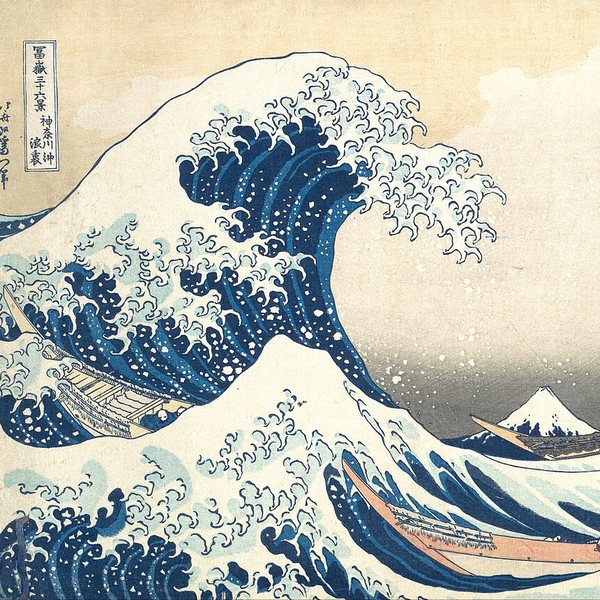
Its best-known sheet, Under the Wave off Kanagawa – the Great Wave – shows boats caught under a towering wave, with Mount Fuji small in the distance. The deep blue came from Prussian blue, a new imported pigment at the time. The print was produced in large numbers for ordinary buyers; European artists later collected and copied Hokusai, and his work shaped Japonisme and Impressionism.
Because the design was printed so often and then reproduced for more than a century, there are huge differences between impressions. In March 2023 an exceptionally fine early impression sold at Christie's New York for $2.76 million – against an estimate of $500,000–700,000. Most «Great Waves» found in homes are later reproductions worth a tiny fraction of that.
Timeline
- 1760Born in Edo (today's Tokyo).
- 1779First published prints, under the name Shunrō.
- 1814First volume of the Hokusai Manga sketchbooks.
- c. 1830–32Thirty-six Views of Mount Fuji, including the Great Wave.
- 1834One Hundred Views of Mount Fuji (illustrated books).
- 1849Dies in Edo, aged 88.
- 2023Great Wave impression sells for $2.76 million at Christie's.
Techniques and media
Hokusai's name appears on everything from unique paintings to modern posters. Knowing which category you have is the key to value.
Colour woodblock prints
Designs cut by professional carvers and printed by hand from several blocks – the Fuji series, waterfalls, bridges.
Illustrated books
Including the Hokusai Manga: printed books whose single pages are often sold separately.
Paintings
Hanging scrolls and paintings on silk or paper – rare and far more valuable than most prints.
Later impressions
Prints pulled from worn or recut blocks after the first editions, often with weaker colour.
Reproductions
Newly carved blocks after his designs, from the Meiji era until today – made by hand, but a different market.
Posters and offset prints
Photomechanical copies of the Great Wave – decorative, without collector value.
What Katsushika Hokusai works sell for
Prices below are public auction results. They show the range – not what a specific piece is worth.
Record: Great Wave, Christie's New York, March 2023. The previous record in 2021 was $1.59 million.
Depends on design, impression, colour and condition – from modest sums to six figures for the famous designs.
Hand-made modern reproductions are decorative objects; posters and offset prints have no collector value.
Highest auction results
| Work | Price | Auction |
|---|---|---|
| Under the Wave off Kanagawa (Great Wave), c. 1831 | $2.76m | Christie's New York, 2023 |
| Under the Wave off Kanagawa (Great Wave), c. 1831 | $1.59m | Christie's, 2021 |
The 2023 impression was described as among the best surviving examples, with sharp lines and strong colour.
Real or not? What to check
With Hokusai, the question is rarely «real or fake?» but «which impression?». Early impressions, later printings, Meiji-era and modern reproductions and posters all exist – and look similar at first glance.
- Look at the back: In a real woodblock print the colours soak into the paper and show through on the back. A modern offset print shows nothing – and under a magnifier its front shows a regular dot pattern.
- Paper: Traditional prints are on soft, fibrous mulberry paper (kozo). Bright, smooth, perfectly even paper points to a later reproduction.
- Seals: Edo-period prints carry the artist's signature plus publisher's and often censor's or date seals. Their combination helps date an impression.
- Lines and colour: Early impressions have crisp key-block lines and fine colour gradations (bokashi). Worn blocks and flat colours suggest a later printing.
- Size: Compare with the standard formats – most landscape and portrait prints are oban, about 39 × 26 cm (roughly A3).
How much is my Great Wave print worth?
Almost all Great Waves on the market are reproductions or posters. A genuine Edo-period impression in good condition is rare; the very best have sold for over $1.5 million. Photos of front, back and any seals give a first indication.
What is a Hokusai reproduction?
A print from newly carved blocks after Hokusai's design, made from the Meiji era onwards and still today. Many are hand-printed and beautiful, but they are not original impressions.
Do you own a work attributed to Katsushika Hokusai?
Start with a free estimate from photos. For a sale, insurance or an estate, order a written appraisal by an independent expert with a notarized signature.
Sources (auction figures as published there):
- Artnet News – A rare version of Hokusai's Great Wave sells for a record $2.8 million
- The Japan Times – Great Wave print sells for $2.76 million
- University of Alabama – Right or wrong? Ukiyo-e reproductions
ArtworkValue is not affiliated with any museum, dealer or auction house. This page does not offer works by Katsushika Hokusai for sale.